
Bonaparte and the consulate
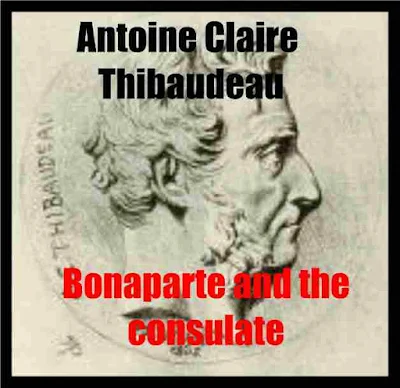 |
| Antoine Claire Thibaudeau |
Bonaparte and the Consulate by Antoine‑Claire Thibaudeau
Antoine‑Claire Thibaudeau’s Bonaparte and the Consulate is a political memoir that examines the transformation of France between 1799 and 1804, the years when Napoleon Bonaparte ruled as First Consul. Written by a man who lived through the Revolution and served in government, the book’s goal is not to glorify Napoleon nor to recount personal adventures, but to explain how the Consulate stabilized France after a decade of upheaval. It is a study of institutions, laws, and governance, showing how revolutionary ideals were reshaped into lasting structures.
The Historical Setting
- The French Revolution (1789–1799) had destroyed the monarchy, unleashed radical change, and left France in turmoil.
- The Directory (1795–1799) proved weak and corrupt, unable to provide stability.
- On 18 Brumaire (November 9, 1799), Napoleon seized power in a coup, ending the Revolution and inaugurating the Consulate.
Thibaudeau’s book begins here, focusing on how Bonaparte reorganized France after the Revolution’s chaos.
Purpose of the Book
Thibaudeau’s central aim is to record the institutional foundations of the Consulate. He deliberately avoids self‑promotion and instead highlights:
- Institutional design: the creation of the Council of State, prefectures, and legislative bodies.
- Legal reforms: the drafting of the Civil Code (later called the Napoleonic Code).
- Centralization of power: Napoleon’s rise from First Consul to Consul for life.
- Political atmosphere: how revolutionary energy was redirected into stable governance.
From the editor's introduction:
Napoleon Bonaparte
as the supreme military genius of modern history is familiar to all of us. There are few who have not some definite idea of his great battles, of the Generals, second only to himself, who surrounded him; few who have not formed in their minds some conception of the fields of Marengo, of Austerlitz, of Wagram, or of Waterloo.
The undying interest in Napoleon's campaigns has of late years been well illustrated by the success of such Memoirs as those of Marbot and Thibault. Marbot, indeed, has become as delightful a friend as D'Artagnan or Rob Roy; while Thiébault, less attractive in himself, has taught us a hundred details of the military history of Europe during the great wars
But when we come to Bonaparte as a civilian, a statesman, a philosopher, I imagine that most of us would find our knowledge confined to a few facts, such as that he destroyed the parliamentary system, restored the Church in France, had some connection with the Code Napoleon, proclaimed himself emperor, subjected France and Europe to a stern, unbending tyranny, shot a bookseller, was overthrown by outraged Europe with England at its head; and finally, as we are told by Master George Osborne, ended his life miserably " on a desert island, that of St. Helena in the South Atlantic Ocean."
Everyone who has seriously studied the life of Napoleon Bonaparte will, I think, agree with me in dividing his career into three very distinct periods. Putting aside his boyhood and early youth, the first period would extend from the 13 Vendémiaire (October 1795) to July 1807; covering the Italian campaigns, the Consulate, the earlier days of the Empire, and closing with the victories of Austerlitz, Jena, Eylau.
Within this period Bonaparte's genius reached its culminating point, both military and civil; while France, reorganised and victorious under his guidance, rose to unquestioned supremacy over the Continent of Europe.
The second period, the period when Napoleon's mind and character were hardenings, becoming each year more arbitrary, more despotic, more driven by wild ambitions and desperate resolves, while France was failing in hope and energy, extends from the Peace of Tilsit, July 1807, to the final fall of the Empire in June 1815.
The third period, St. Helena, was the period of disease, hopelessness, and death. It would have been, I think, more just to the memory of Napoleon himself, and more in the interest of history had the Memorial of St. Helena and all the other contemporary records of the petty jealousies and sordid squabbles which took place there, been left unwritten or promptly burnt. For my own part, in editing these Memoirs of the Consulate, I have resolutely resisted every temptation to compare notes with Napoleon's words at St. Helena. .
Table of Contents (highlight only)
- Editor’s Introduction
- Chronological Table of Events (Nov 1799 – May 1804)
- Note on the Constitution of the Year VIII
- Publisher’s Preface (1827)
Main Chapters
1. Bonaparte and his Court — Life at the Tuileries, Malmaison, and Saint‑Cloud (1800–1804).
2. The Tribunat and Corps Législatif (1800–1801) — Early debates and legislative struggles.
3. The Tribunat and Corps Législatif (1801–1802) — Continued reforms and political maneuvering.
4. Crime of 3 Nivôse (Infernal Machine) — The assassination attempt of December 1800 to January 1801.
5. Émigrés, Army, Navy, Colonies (1800–1802) — Reconciliation with émigrés, military organization, and colonial policy.
6. Public Instruction and the Institute (1800–1803) — Education and intellectual life under the Consulate.
7. Peace and War — Treaties of Lunéville and Amiens (Dec 1800 – May 1803).
8. Lists of Notability and the Legion of Honour (1801–1802) — Establishing new honors and systems of merit.
9. The Concordat (1801–1802) — Napoleon’s reconciliation with the Catholic Church.
10. Council of State Debates on the Civil Code (1801–1802) — Drafting the Napoleonic Code.
11. Council of State, Missions, and Debates — Newspapers, plays, and control of public opinion (1801–1802).
12. Consulate for Life (May–June 1802) — Reform of the Constitution, Napoleon consolidates authority.
13. Consulate for Life (June–Oct 1802) — Continued constitutional reforms.
14. Settlement of Switzerland (Sept 1802 – Feb 1803) — The Act of Mediation and Napoleonic influence abroad.
15. Discontent in the Army, Ministry Changes, and Foundation of the Empire (1802–1804) — Transition from Consulate to Empire.
Editor's noteThe French name was originally Mémoires sur le Consulat, 1799 à 1804. Later, to reach a wider audience, publishers reissued it as Le Consulat et l’Empire ou Histoire de la France et de Napoléon Bonaparte. The shift in title shows how Napoleon’s name was used as a powerful marketing tool, even when the book’s real focus was institutional history.
Download Bonaparte and the consulate 19 MB