
The Nicomachean Ethics of Aristotle
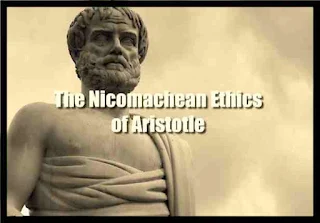
The Nicomachean Ethics of Aristotle is the most famous book for ethics in the western world. The book inspired many authors to write about ethics. This book was imitated, criticised and studied in universities. Artistole was practical not idealist, he defined the good as what helps purpose.
Study notes
1. The Good = Purpose
"The good is that at which all things aim."
- Everything has a telos (end/purpose). A "good" thing fulfils its purpose — a good knife cuts well, a good eye sees well.
- Human uniqueness: reason/rationality. So our good = rational activity guided by virtue, over a complete life.
2. Virtue = The Golden Mean
- Virtue is the middle between two extremes:
- Courage = between cowardice ↔ recklessness
- Generosity = between stinginess ↔ wastefulness
- Temperance = between insensibility ↔ self-indulgence
- Virtue isn't a feeling — it's a habit: we become just by doing just acts.
3. Two Types of Virtue
- Moral virtue → habits, upbringing, practice (how we act)
- Intellectual virtue → teaching, wisdom, understanding (how we think)
- Highest wisdom: Phronesis = practical wisdom — knowing what to do, when, and why
4. Happiness Isn't Pleasure
- Pleasure is a byproduct, not the goal
- Eudaimonia comes from: virtuous action, friendship, contemplation, living in harmony with others
- Needs external goods too: health, friends, resources — you can't flourish in isolation
5. Friendship is Essential
- Three kinds of friendship:
Utility — useful to each other
Pleasure — enjoyable company
Virtue/perfect friendship — wishing good for the other, for their own sake — highest form
A translation of a work so well known as Aristotle's Ethics scarcely needs any preface. It might perhaps seem superfluous to do again what has already been done so often, but everyone who is acquainted with the extant English translations knows that valuable as they are, they leave much to be desired.
I am quite conscious that the version which is now offered to the public is still very far from being adequate, yet I venture to hope that it may do something towards supplying an acknowledged want and that it may be of some service to those who (whether they be scholars or not) wish to know what the greatest thinker of antiquity has to say upon a subject which is of such a nature that what a great man of any age says upon it is usually of more permanent value than what he says on any other subject.
the book details :
I have, of course, made free use of other translators and commentators, and wish here to make a full acknowledgement of my obligations. But I must more particularly express my thanks to my friends Mr A. C. Bradley and Mr J. Cook Wilson, the former of whom has been kind enough to read the whole of the proof sheets, and the latter a large portion of them. To both, and especially to the former, I am indebted for many valuable suggestions. But, as I have sometimes persisted in my own opinion in spite of their dissent, the reader must not hold them responsible for any of the errors he may detect.
The notes perhaps require some apology; they may appear to be too many for footnotes to a translation, but they are certainly too few for a regular commentary, leaving without explanation many points that much need it. But if this translation should meet with any favour, I purpose before long to follow it up with an Introduction, in which I shall hope to some extent to make good this deficiency.
Where their suggestions have not been adopted, I trust they will believe that my persistence is due neither to carelessness nor to an unwillingness to learn, but to the fact that after full consideration I find myself unable to agree with them.
An Introduction, promised in the Preface to the first edition, is, I regret to say, not yet finished.; but I still hope to publish it before long. I omitted in the first edition to state that I have in the main followed Bekker's text (Berlin, 1845), and that when I have departed from it I have generally notified the fact; that the chapters and sections are those of Zell; and that whenever I have inserted in the text explanatory words of my own,.
Some contents:
1. In all he does man seeks some good as end or means ... 1
2. The end is the good; our subject is this and its science Politics 2
3. Exactness not permitted by subject, nor to be expected by the student, who needs experience and training 3
4. Men agree that good is happiness, but differ as to what this is. We must reason" from facts accepted without question by the man of trained character 5
5. ' The good cannot be a pleasure, as some hold, nor honour, nor virtue 6
6. Various arguments to show against the Platoni-ts that there cannot be one universal good: even if there were it would not help us here 8
7. The good is the final end, and happiness is this. To find it
we ask, What is man's function? Consulting definition of happiness 12
8. This view harmonizes various current views 18
9. Is happiness acquired, or the gift of Gods or chance? ... 22
10. Can no man be called happy during life? 23
11. Cannot the fortunes of survivors affect the dead? 27
12. Happiness as the absolute end is above praise 28
13. Division of the faculties and the resulting division of the virtues 30
Download PDF ebook - 15.7 MB